
Purpose
The Continental Liaison Unit for Enquiries exists to coordinate evidence, witnesses, information and responsibility when a matter spans more than one jurisdiction, department, vehicle, hotel room or interpretation of events.
Our remit begins where another body's remit ends and, in several cases, where that body insists its remit never began.
The motto
QUAESTIO UBIQUE
Traditionally rendered as “enquiry everywhere”. The Directorate's preferred practical translation is: somebody should probably ask.
The Latin has been reviewed by Legal, who confirmed that nobody has yet complained in Latin.
A brief institutional history
| Year | Development |
|---|---|
| 1957 | An informal liaison committee forms after three administrations open the same case under different titles and each requests the other two's paperwork. |
| 1962 | The committee becomes permanent after an international meeting spends two days establishing that nobody present owns the briefcase in the middle of the table. |
| 1974 | First confirmed cross-border memorandum arrives at the office for which it was intended. |
| 1993 | Email introduced. Security policy requires each email to be printed immediately and placed in a folder. |
| 2004 | Digitisation programme reduces seventeen paper forms by replacing them with twenty-six printable PDFs. |
| 2016 | A strategic review recommends “greater clarity”. The phrase is adopted without further definition. |
| 2021 | Remote working pilot unexpectedly increases productivity. An internal inquiry is commissioned. |
| 2026 | C.L.U.E. remains operational. No satisfactory explanation has been found. |
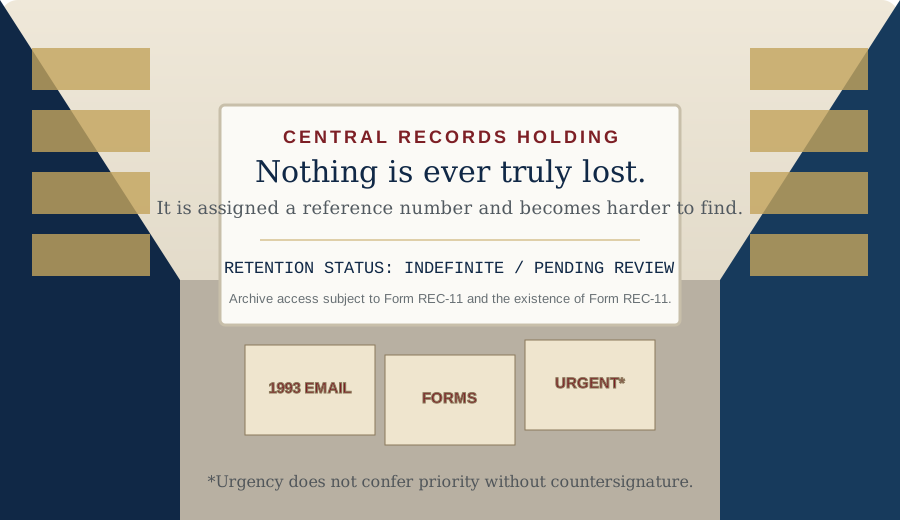
We keep almost everything.
C.L.U.E. retains operational records according to schedules approved by Records Management, Legal, Information Governance and the person who knows which cupboard contains the older schedules.
Material may be destroyed when it is no longer required, provided the destruction request, retention review and destruction-confirmation record are themselves retained indefinitely.
Evidence before certainty
Confidence is welcome, but must queue behind evidence and carry identification.
Record the inconvenient detail
The detail everyone dismisses is often the detail a review panel will ask about six months later.
Do not improve a story
Reality is usually strange enough. Where it is not, wait. Someone will eventually make it worse.